Showing posts with label aparigraha. Show all posts

Sunday, April 22, 2018

The Consequence of Consumption


I watched a chilling Walmart commercial the other day. The premise: A child keeps spitting out a pacifier, which the family's dog then slobbers all over. The kid also drops a sippy cup in the mud. The mother decides to reorder pacifier after pacifier and cup after cup instead of sterilizing the originals. The commercial ends with the dog surrounded by pacifiers and the mom patting the dog with a “What can you do?” sort of smile on her face. In the background, singers croon, “I just can't get enough, I just can't get enough.”

The commercial, and the message behind it, horrifies me. Particularly in the light of all our environmental problems. A friend shared a post on facebook recently depicting the state of our world's beaches in Bali, the Philippines, Hawaii. Gone are pristine sandy shores. In their place we have cups and cutlery, we have bottles and bags. In the comments many people said, “Pick up after yourselves! Throw stuff away!” I agree, throw stuff away, but that doesn't address the whole problem.
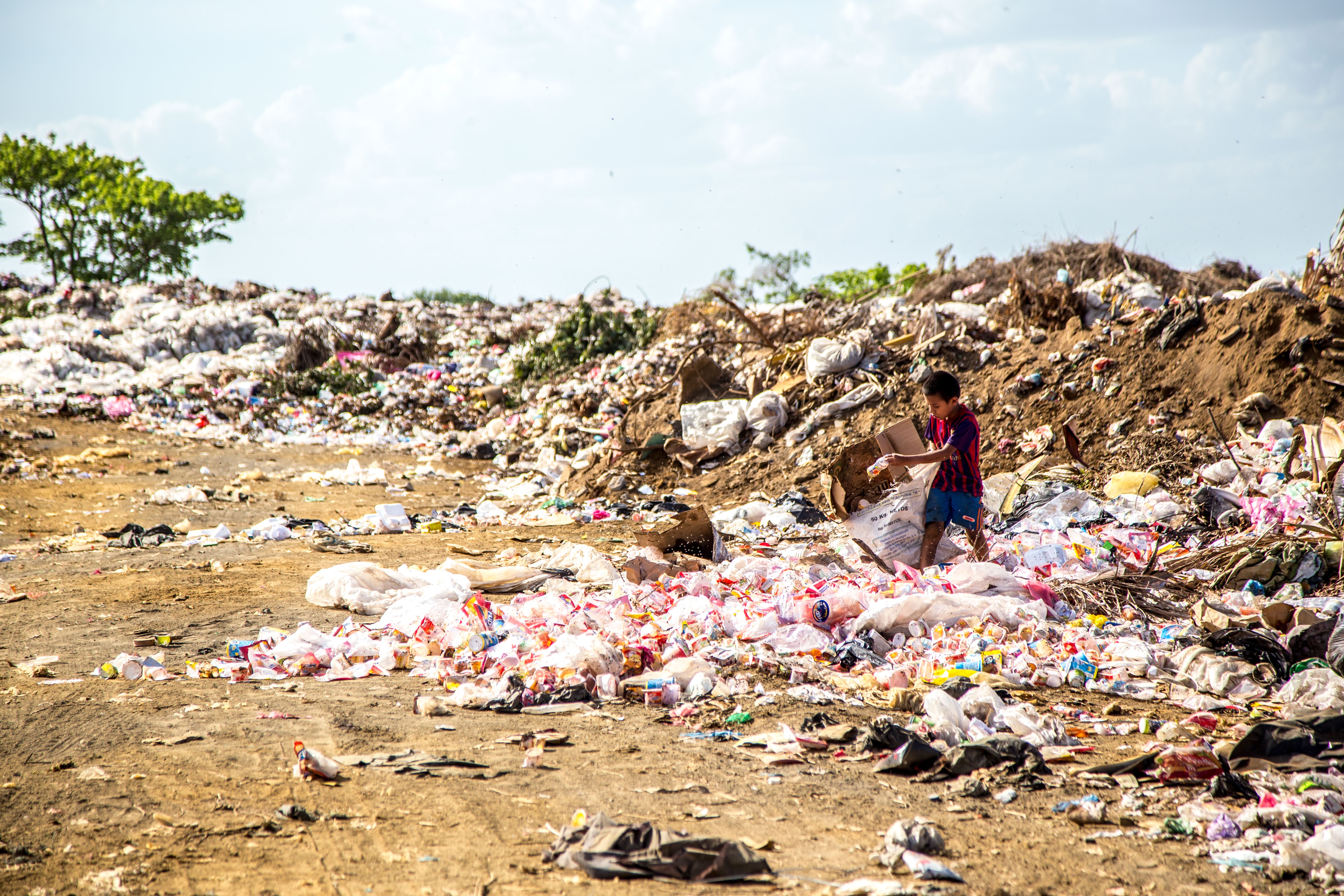
It's not a beach, but it is a site in Nicaragua. Photo by Hermes Rivera on Unsplash.

According to Greenpeace, even when plastic waste is collected, it can blow away and end up in rivers or oceans. Major rivers around the world carry an estimated 1.15 million to 2.41 million tons of plastic into the sea every year – the equivalent of 100,000 garbage trucks. Not all of that comes from plastic blowing away, obviously it also comes from littering, but I'd like to point out the trash still goes somewhere. We think once the garbage truck picks it up the problem is solved, but it's not. Commercials like Walmart's divorce us from the consequences of our actions. Reordering one pacifier after another because the dog drooled all over it and throwing perfectly good pacifiers away contributes to waste. I read somewhere that the most important part of the mantra “reduce, reuse, and recycle” is “reduce,” but that doesn't contribute to economic growth so we don't focus on it as much.

In yogic philosophy there is a tenet called aparigraha. It means non-indulgence. Specifically, not indulging in the amenities and comforts of life that are superfluous for the preservation of physical existence. Usually people have a hard time with that one. “Does that mean I can't buy the latest iphone? What about a new computer? Am I supposed to live in the woods off of rainwater and tree bark?” Yes! Just kidding. We can't all live in the woods. Also, what is essential for our survival changes with time, place, and person. Perhaps 10 years ago it wasn't crucial for everyone to have internet, but these days in my community it's another utility like gas and electricity.

What I never grasped until watching the Walmart commercial is aparigraha isn't about deprivation. It's not being a martyr, living off of less so that everyone gets their fair share. Non-indulgence at least from my perspective is about Earth. It's about paying respect to Mother Nature and realizing that my actions contribute to the destruction of the environment, and destroying the environment means more pollutants and poorer health. It means wiping out certain species. It means natural disasters like the ones we're currently experiencing. If the environment we reside in becomes a toxic wasteland, where are we supposed to go?

I could end this post here and proclaim the planet is doomed and we're all screwed, but I won't. I want to again go back to one of my favorite quotes from my spiritual teacher who said, “Difficulties can never be greater than your capacity to solve them.” Did you know scientists recently created an enzyme that eats plastic? It turns plastic back into a more usable form. I'm confident more things like that will happen, but more mindfulness is required on our part. Breaking our addiction to consumerism and thoughtlessness will go a long way in creating a world in which we all want to live.

I dream of a world where we reduce our consumption. A world where we think twice before casually throwing something away. A world where we understand non-indulgence helps the environment and ultimately helps us. A world where we treat nature with the care and reverence it deserves.

Another world is not only possible, it's probable.

Sunday, March 10, 2013

A Dog-Help-Dog World

I don't often write while I'm on vacation, but I'm not on vacation even though I'm traveling so you're getting a blogpost! AWIP (Another World is Probable) is a very introspective blog, obviously. I'm an introverted person, so usually I write about things we can do individually to make our lives better and make the world better. This week I'm taking more of an outward focus.

When I interviewed for a potential sublet the woman asked me what is most important to me in terms of living with someone else. My immediate answer was, "being considerate." That's really the heart of it for me. Being considerate means thinking of other people, means selflessness instead of selfishness. My absolute pet peeve is when someone is being inconsiderate. I'm getting up in arms just thinking about it.

It occurred to me this week just how important it is to think of other people. We (in the West) often have this view of the world and how it's "dog eat dog." There's this idea you have to take what's yours, be selfish, get your own needs met. That's true to a degree but it's imbalanced. You know where "dog eat dog" gets us? Just watch this video on the distribution of wealth in the U.S.
I covered my eyes for parts of this video. I couldn't even look at the infographics. I am so horrified, I can't even tell you. ONE PERCENT of Americans have FORTY PERCENT of the nation's wealth. ONE PERCENT. And 80% of the nation has to split up 7% of the wealth. Guys, that's messed up. And you know how we got that way? Because everyone was looking out for themselves.

There's a concept in yoga, a social norm, called aparigraha. It means living with the minimum necessities. I've struggled with this concept for years. My parents and I would talk about what it meant. Does getting a flat-screen T.V. fall under a minimum necessity? We would agonize over this, somehow believing it was an internal thing to live by. It's not. What I mean is aparigraha is a way of ensuring everyone gets their needs met. It's the opposite of hording. It's freeing up resources. When aparigraha is not followed we end up with the inequitable distribution of wealth in the U.S.  

I've been hesitant to talk about this because I don't want to offend anyone, but part of the problem is this law of attraction idea that if you think about becoming a millionaire then you will. Well, yes, you may attract all that money to you, but the idea everyone can be a billionaire is a load of phooey. Energy is unlimited but money is not. Money comes from trees, or silver, or gold, or nickel, or whatever, and that means it's finite. There is a limit to how much money can be printed. So no, everyone cannot be a billionaire. And everyone cannot be a billionaire because while someone is practically wiping their butt with money, there's someone else who's scrimping for change. That's just the way it is.

Other people far more intelligent than me have written about solutions to all this, but a great place to start on the individual level is with the notion we live in a dog-eat-dog world. We don't have to you know. We blame society but we forget we are society. We change all this. Sure, we change our policies and the like, but it's also important to change the underlying mentality. There is enough for all of us but it starts with being considerate of other people. Of noticing what's going on around us. Of compromising to ensure not only my needs get met but those of the people around me as well. I don't know about you but I'd much rather live in a dog-help-dog world.

I dream of a world where every single person gets all of their needs met. A world where there is a more equal distribution of resources. A world where we think about the people around us, which means you're thinking of someone else, but they're also thinking of you. A world where we share what we have without differentiation as we all move as one together.

Another world is not only possible, it's probable.